
CRM consulting and requirements analysis
We clarify objectives, user groups and existing problems. The result is a prioritized requirements list that supports informed decisions.
Bring customer data and workflows together in one system
With custom CRM development based on EspoCRM, we combine consulting and process analysis with suitable customization and automation. We handle data migration and interfaces and offer optional hosting in Germany. This gives sales, customer service and operational teams reliable data, clear responsibilities and fewer manual handovers.
A custom CRM is useful when sales, service or operational teams can no longer work reliably with standard screens. Parallel spreadsheets, data silos, manual handovers and inconsistent sales processes leave information missing when decisions are made or requests are handled.
We start with your workflows rather than a list of features. Through our IT consulting and software development, we clarify roles, data and handovers. The CRM fits your organization instead of forcing it into rigid software logic.
We combine modules for your project. You receive clear decisions, not an overloaded system.
We clarify objectives, user groups and existing problems. The result is a prioritized requirements list that supports informed decisions.
We describe workflows, responsibilities and the information people need. Entities, fields and relationships then represent your business logic in a clear way.
We configure interfaces, views, statuses and roles in EspoCRM. Standard functionality remains in place wherever it already meets the requirement.
We add specific business functions where they are genuinely missing. Extensions follow clearly defined processes and a maintainable architecture.
Tasks, reminders, approvals and messages can be triggered by rules. People retain control over decisions and exceptional cases.
We connect suitable systems through REST APIs, webhooks or agreed import routes. Data flows are documented and tested for error scenarios.
Existing data is analyzed, mapped and cleaned. Test runs expose issues before the production changeover takes place.
Metrics are derived from specific management questions. For more advanced needs, we connect CRM data to our data visualization and BI solutions.
Access is structured around tasks and responsibilities. Users see only the data and functions they need for their work.
We involve future users early and explain new ways of working. Training focuses on real tasks rather than abstract feature lists.
After launch, we prioritize improvements based on use and feedback. Updates and changes are prepared and tested in a controlled way.
If required, we operate the technical environment on infrastructure in Germany. Scope, responsibilities, backups and updates are defined in the operating concept.
EspoCRM can be configured for different business processes. The decisive factor is a shared data model instead of many isolated tools.
Contacts, opportunities, activities and next steps are managed transparently.
Statuses, responsibilities and documents follow a traceable workflow.
Requests, deadlines and processing statuses are organized centrally and by role.
Relationships, contacts and open topics remain visible across teams.
Master data, fees, documents or approvals can be managed systematically.
Customer-related tasks, deadlines and handovers are coordinated in one place.
Candidates, vacancies and communication can follow clear status stages.
Rules trigger tasks without fully automating professional decisions.
EspoCRM provides an open and extensible foundation for custom CRM software. Data models, layouts, roles and processes can be configured and supplemented with custom modules. REST APIs and webhooks enable controlled exchange with other applications, while the responsive interface supports mobile use.
EspoCRM Core generally has no user-based subscription fee. Development, extensions, infrastructure, operation and support still require resources and are calculated transparently. The suitable components depend on the actual requirements.
An open-source foundation reduces dependency on a closed licensing model.
Teams receive views and access permissions that match their responsibilities.
REST APIs and webhooks support documented data flows.
New modules can be added after a reliable pilot has been established.
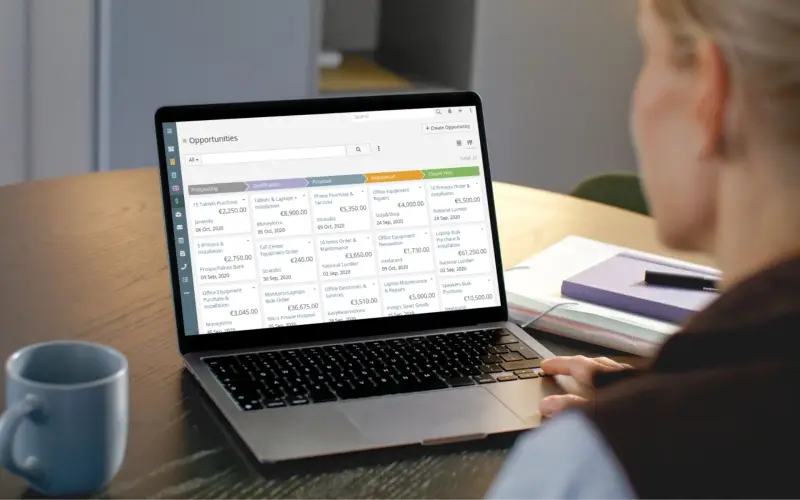
A CRM delivers the greatest value when information flows without duplicate entry. Feasible categories include ERP, document management, email and calendars, marketing, telephony, support, BI and specialist applications.
A REST API provides defined access to data. Webhooks report events such as status changes; scheduled synchronization reconciles data at agreed intervals. We clarify ownership, direction, frequency and error handling before implementation.
A migration is a business data project. We do not promise blanket completeness; instead, we make rules, checks and unresolved issues visible before the changeover.
Formats, volume, duplicates and data quality are documented.
Fields, values and cleansing rules receive an unambiguous mapping.
A defined dataset is transferred under realistic conditions.
Responsible users verify samples, totals and critical relationships.
Final migration, freeze periods and responsibilities are coordinated.
After the changeover, we check results and address documented discrepancies.
Data protection does not result from a product promise. We plan the technical and organizational implementation around the company’s requirements, including hosting location, access, roles, logging, deletion and retention. Legal assessments remain with the responsible specialists.
Permissions follow responsibilities; strong authentication and secure connections are planned according to the required level of protection.
Scope, intervals, retention and recovery tests are agreed in the operating concept.
Changes are deployed in a controlled way, and relevant activities can be logged for traceability.
Data processing, deletion and retention are coordinated with the company’s responsible stakeholders.
You'll receive a shared vision, initial priorities, and a clear basis for decision-making regarding the next step.
We document users, workflows, handoffs, and issues in a clear process overview.
The result is a set of prioritized requirements, a data model, roles, and coordinated integration points.
An early, limited release makes core processes verifiable and gathers concrete user feedback.
Functions are developed in verifiable steps; decisions and open issues remain transparent.
Test data, technical acceptance tests, and documented error cases lay the groundwork for a controlled transition.
Users receive task-based training, instructions, and a customized onboarding plan.
After launch, feedback will be prioritized and meaningful improvements will be planned.
CRM projects connect technology, processes and organizational change. We guide you transparently across these interfaces.
Technical decisions are derived from business workflows and specific objectives.
You discuss priorities and open questions directly with the project team.
A clear core can launch first and then grow in a controlled way.
Extensibility and data access are considered early in the architecture.
Feedback from everyday work informs the pilot and testing stages.
If required, we support hosting, maintenance and continued product development.
Our case studies document EspoCRM applications for membership, certification and publicly funded programs—including migration, roles and automation.

Further Education Hamburg e. V.
We have set up an EspoCRM membership management system for Weiterbildung Hamburg. It integrates membership fees, certifications, and audits into a single …
View case study
Koordinierungsstelle Weiterbildung und Beschäftigung e. V.
For KWB, an EspoCRM solution integrates several ESF and federally funded programs. Registration, action planning, documentation, and reporting follow a …
View case study
Further Education Hesse e. V.
For Weiterbildung Hessen, EspoCRM integrates the member portal and certification management. Applications, exams, and renewals follow a unified workflow. …
View case studyEingesetzt bei






Key information for your project decision