The nervous system of the global economy.
From the assembly line to the front door: Intelligent process chains, digital warehouse environments, and the reinvention of just-in-time economy.
Data, Drones & Dynamics.
Logistics today is much more than "moving boxes." It is the critical competitive factor in a globalized world. When the supply chain stalls, production lines come to a halt and shelves remain empty.
We are experiencing a paradigm shift: For years, "Just-in-Time" and maximum cost minimization were the standard. Today, resilience and agility are paramount. Companies are restructuring their supply chains – from single sourcing to multi sourcing, from global to "local-for-local." We understand the complexity of modern intralogistics and know that a supply chain manager today must understand as much about data science as about pallet spaces.
Value chain
The supply chain encompasses the entire flow of goods, information, and financial resources from raw material suppliers to the end customer. It can be divided into the following core areas:
1. Procurement Logistics (Sourcing):
The connection of suppliers to production. This involves inventory management, supplier evaluation, and the synchronization of material flows (JIT/JIS).
2. Intralogistics & Warehousing:
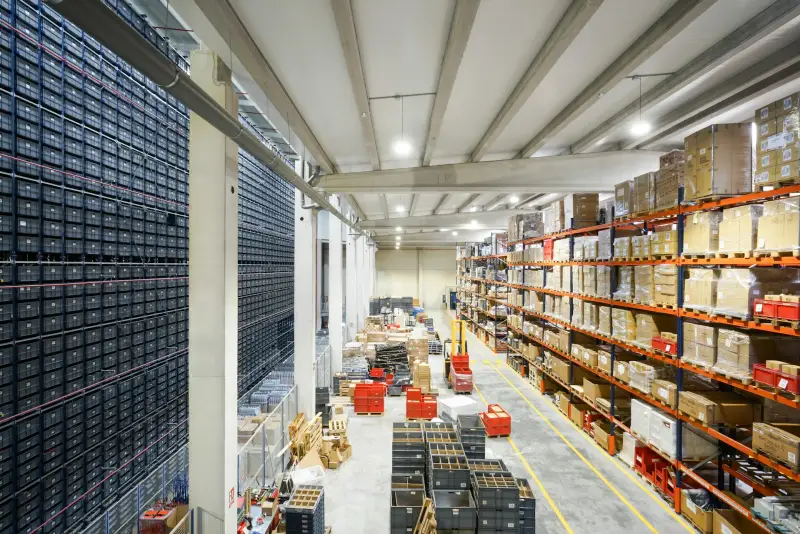
The heart of the operation. Internal material flow, storage, order picking, and packaging. This is where the highest automation occurs – through Autonomous Mobile Robots (AMR), shuttle systems, and fully automated high-bay warehouses.
3. Distribution Logistics:
The distribution of finished goods via central warehouses (hubs) and regional warehouses (spokes) to the customer. Network planning and location selection are strategic key issues here.
4. Last Mile:
The most expensive and complex part of the chain. Delivery to the doorstep, characterized by high time pressure, customer demands (same day delivery), and urban traffic problems.
5. Reverse Logistics (Returns):
Particularly crucial in e-commerce. The efficient return, inspection, refurbishment, and restocking of goods. Often an underestimated cost driver and sustainability factor.
Market dynamics
E-Commerce & Quick Commerce
Customer expectations for speed (15 minutes to next day) force decentralized warehouse structures and high process speed.
De-globalization & reshoring
Companies are bringing production and storage back to Europe or increasing safety stocks ("Just-in-Case") to safeguard against global crises.
Labor shortage (Blue Collar)
It is becoming increasingly difficult to find personnel for warehousing and handling. This drives up wages and accelerates investments in robotics.
Land scarcity
Suitable plots for logistics properties (brownfield/greenfield) are rare and difficult to implement in terms of regulatory approval, especially in metropolitan areas.
Subsegments
Contract logistics
Acquisition of permanent, complex logistics tasks. Often including value-added services such as assembly, repair, or display construction.
E-Commerce Fulfillment
Specialized in small B2C shipments, high peaks (Black Friday), and fast returns management.
Automotive Logistics
Highest precision (Just-in-Sequence) for the line supply of automotive manufacturers. Area forwarders and supply chain integration.
Pharma & Healthcare Logistics
GDP-compliant (Good Distribution Practice) storage and transport. Temperature-controlled, documentation required (batch tracking) and safety-critical.
Industrial- und Produktionslogistik
Works logistics, production supply, and forklift traffic within industrial facilities.
Our customers in the industry


Regulation & Standards
The warehouse and contract logistics are also subject to strict regulatory requirements:
- Supply Chain Due Diligence Act (LkSG): Obligates monitoring human rights and environmental standards along the entire chain – not just with direct suppliers.
- Packaging Act (VerpackG): Strict quotas for the return and recycling of packaging materials.
- Occupational Health and Safety: Particularly in manual warehouses, strict regulations apply for accident prevention (forklift traffic, lifting/carrying).
- Customs and Foreign Trade Law: Compliance for imports and exports, sanctions list checks, and correct classification of goods.
- Hazardous Substances Ordinance: Specific requirements for the storage and handling of chemicals or batteries (lithium-ion).
Technology & Data
Technology has revolutionized logistics ("Logistics 4.0"):
- Warehouse Management Systems (WMS): The "brain" of the warehouse. Controls storage locations, optimizes routes, and synchronizes orders.
- Robotics & Automation: From "goods-to-person" systems (Autostore) to exoskeletons that assist employees in lifting.
- Digital Twin: Simulation of warehouse processes on a computer to identify bottlenecks before they occur in reality.
- Process Mining & AI: Analysis of digital traces in ERP systems to uncover inefficiencies in processes and predict inventory (Predictive Planning).
- Blockchain: For seamless traceability, e.g., in food or pharmaceutical logistics.
Sustainability & Transformation
Sustainability is changing from an image factor to a 'license to operate':
- Green Warehousing: Warehouses become power plants. Photovoltaics on the roof, heat pumps, and intelligent LED lighting control.
- Packaging Reduction: Use of algorithmic packaging calculation to avoid "air transport." Reusable container systems replace single-use cartons.
- Circular Economy: Logistics as an enabler of the circular economy. Products are designed and logistically managed so they can be repaired or recycled.
- CO2-neutral Delivery: Cargo bikes and e-transporters in last-mile distribution.
Outlook
The future of logistics is omnichannel and hyper-local. The traditional distinction between online and offline retail is blurring. Stores are becoming mini-warehouses ("Ship-from-Store"), urban parking garages into "Micro-Fulfillment Centers". The shortage of skilled workers among warehouse staff and dispatchers will make automation a necessity, no longer an option. Artificial intelligence will make the supply chain more autonomous ("Self-driving Supply Chain"), responding to disruptions before humans notice them.
Are you looking for supply chain architects?
Whether logistics manager, supply chain manager or warehouse automation expert – we find the minds that not only manage your processes but also optimize them. From the warehouse floor to the boardroom.
Arrange a conversation